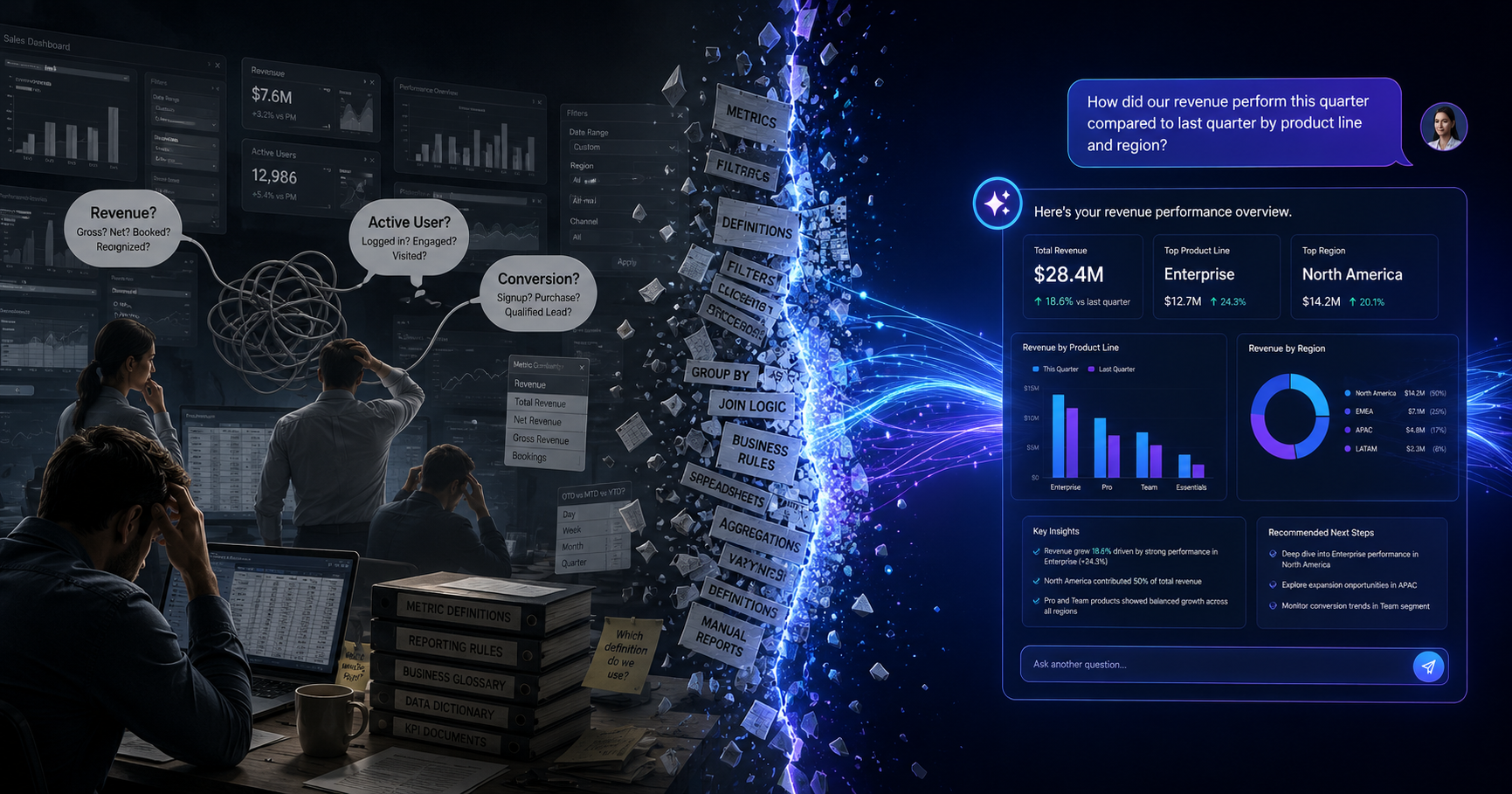
The Promise of Self-Service Analytics
For nearly two decades, Business Intelligence vendors have been selling the same dream.
Anyone in the company should be able to answer their own questions without waiting for the data team.
It sounds reasonable.
A marketing manager wants to know which campaign drove the most revenue.
A sales leader wants to understand conversion rates by region.
A product manager wants to see retention trends.
The promise was simple:
Give everyone access to dashboards and analytics tools, and they'll become data-driven.
That promise powered the rise of tools like Tableau, Looker, Power BI, Mode, and dozens of others.
Billions of dollars were invested.
Thousands of dashboards were built.
Yet most organizations still rely on analysts for answers.
Self-Service Analytics Didn't Actually Succeed
Most companies have access to modern BI tools.
Most companies still have analytics bottlenecks.
That should tell us something.
If the technology worked as promised, data teams wouldn't spend their days answering questions like:
- "Can you pull churn numbers for enterprise customers?"
- "What's our MRR growth excluding expansions?"
- "How many active users do we have this quarter?"
- "Can I get this dashboard filtered differently?"
Instead, analysts remain the translators between business questions and data.
The dashboards exist.
The data exists.
The bottleneck remains.
Why?
Dashboards Were Never the Problem
The common explanation is that analytics tools are too complicated.
That's only partially true.
Modern BI tools have become dramatically easier to use.
Drag-and-drop interfaces work.
Visualizations are straightforward.
Filters are intuitive.
The real problem lies elsewhere.
The problem is that business language is messy.
Humans don't ask questions the way databases expect them.
Business Language Is Inherently Ambiguous
Imagine someone asks:
"Show me active customers."
Seems simple.
Except what exactly is an active customer?
Possible definitions include:
- Logged in during the last 30 days
- Made a purchase in the last 90 days
- Has an active subscription
- Generated revenue this month
- Opened the product at least once this week
Every company defines it differently.
Now imagine someone asks:
"Show me revenue."
Revenue according to whom?
- Booked revenue?
- Recognized revenue?
- Net revenue?
- Gross revenue?
- Revenue excluding refunds?
The dashboard isn't struggling.
The database isn't struggling.
The definition is struggling.
The Industry's Attempt: Semantic Layers
The analytics industry recognized this problem years ago.
That's why semantic layers became popular.
A semantic layer attempts to define business concepts in a centralized place.
Instead of every dashboard calculating revenue differently, everyone references the same metric.
In theory, this solves the ambiguity problem.
In practice, it helps—but doesn't eliminate it.
Because business definitions evolve.
Teams disagree.
Exceptions appear.
Metrics change.
Organizations merge.
Products expand.
The semantic layer becomes another system that requires maintenance.
Useful.
Necessary.
But not sufficient.
Why Most Employees Stopped Using Dashboards
Here's an uncomfortable truth.
Most business users don't actually want dashboards.
They want answers.
A dashboard is simply one possible route to getting an answer.
When executives ask:
"Why did revenue decline in Europe?"
They don't want to:
- Open a dashboard
- Select filters
- Compare periods
- Export data
- Build a chart
- Investigate anomalies
They want the answer.
The dashboard is merely a tool.
Unfortunately, self-service analytics often confused access to dashboards with access to answers.
Where AI Changes the Game
AI introduces a fundamentally different interface.
Instead of navigating dashboards, users can express intent.
They can ask:
"Why did enterprise churn increase last month?"
Or:
"Compare retention between customers acquired through paid search and referrals."
Or:
"What changed after we launched pricing version three?"
The user no longer needs to understand tables, joins, dimensions, or dashboard navigation.
The interaction becomes conversational.
That's a massive shift.
But AI Alone Doesn't Solve the Problem
There's a misconception that large language models magically solve analytics.
They don't.
The ambiguity still exists.
When someone asks:
"Show me active customers."
AI still needs to know what active means.
The difference is that AI can now participate in resolving ambiguity.
Instead of silently producing the wrong chart, it can ask:
"Do you mean customers who logged in during the last 30 days or customers with active subscriptions?"
That's a fundamentally different experience.
The system becomes collaborative rather than static.
The Future Isn't Self-Service. It's Guided Analytics.
The phrase self-service analytics may have led the industry in the wrong direction.
It implied users should become analysts.
Most users don't want that.
What they want is confidence.
Confidence that:
- The numbers are correct
- The definitions are consistent
- The context is understood
- The answer reflects business reality
The future isn't about teaching everyone SQL.
It's about building systems that understand business context well enough to translate intent into trustworthy answers.
What Successful Analytics Will Look Like
The winning analytics platforms won't be the ones with the most dashboards.
They'll be the ones that best understand business language.
The stack will likely include:
| Layer | Purpose |
|---|---|
| Data Warehouse | Stores data |
| Semantic Layer | Defines business concepts |
| AI Layer | Understands intent |
| Analytics Engine | Retrieves and analyzes data |
| Visualization Layer | Explains findings |
Notice what's missing.
The dashboard is no longer the center of the experience.
It's simply one output format among many.
Sometimes the best answer is a chart.
Sometimes it's a table.
Sometimes it's a paragraph.
Sometimes it's another question.
The Real Reason Self-Service Analytics Failed
Self-service analytics didn't fail because dashboards were difficult.
It failed because business language is ambiguous.
For fifteen years, the industry focused on making charts easier to build.
The harder problem was understanding what people actually meant.
AI doesn't magically eliminate ambiguity.
But for the first time, we have systems capable of participating in the conversation.
And that's why the next generation of analytics may finally deliver on a promise the industry has been making since the beginning.
Not self-service dashboards.
Self-service answers.