Your KPI Meeting Might Be a Status Update in Disguise
If your KPI meeting ends with "let's investigate and come back next week," it wasn't a KPI meeting.
It was a status update.
Every Monday, leadership teams gather around dashboards, spreadsheets, and performance reports. Revenue is up. Churn is down. Activation dipped. Support tickets spiked.
Someone explains why.
Someone else asks a follow-up question.
A few action items are captured.
And everyone agrees to revisit the topic next week.
The meeting ends feeling productive.
But nothing was actually decided.
This is the uncomfortable reality of many KPI reviews: they create explanations, not decisions.
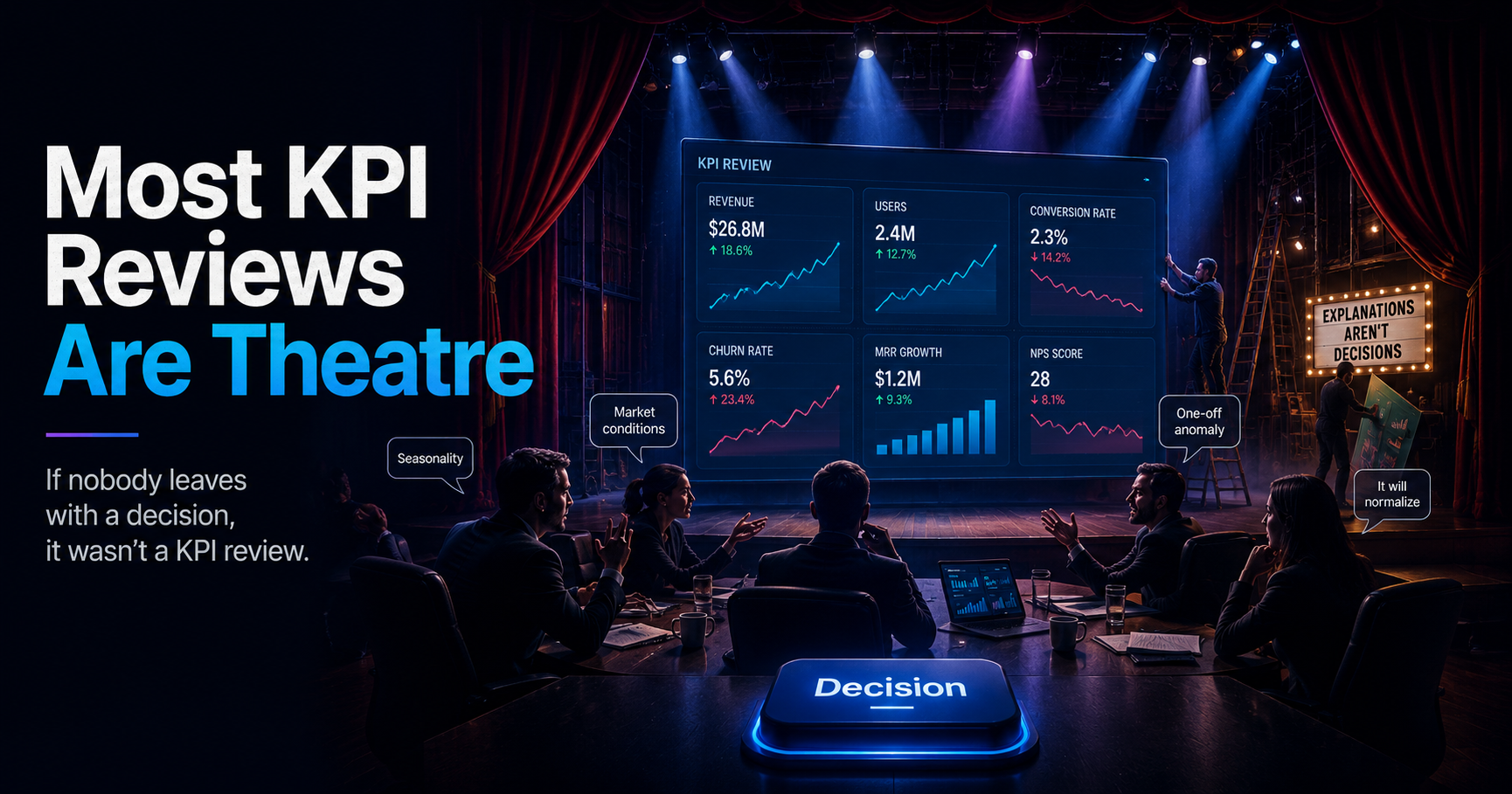
The Rise of Accountability Theatre
Most organizations believe KPI reviews exist to drive accountability.
In practice, many become a performance.
Teams arrive prepared to explain what happened rather than determine what should happen next.
The conversation follows a familiar script:
- A metric misses target.
- The owner explains the reason.
- Leadership asks clarifying questions.
- More analysis is requested.
- The topic is deferred.
No decision is made.
No tradeoff is resolved.
No resource allocation changes.
No priority shifts.
Everyone leaves having demonstrated awareness of the problem, which creates the illusion of accountability.
But awareness is not accountability.
Accountability starts when someone commits to a decision and accepts responsibility for the outcome.
Why Explanations Feel Productive
Humans are naturally drawn to narratives.
When a KPI moves unexpectedly, the first instinct is to understand why.
That's reasonable.
The problem is that explanation becomes the destination instead of the starting point.
A team spends 45 minutes debating:
- Why conversion dropped 3%
- Why sales cycles increased
- Why retention stalled
- Why usage patterns changed
The room feels engaged because everyone is discussing data.
Yet the company remains exactly where it started.
Knowing why something happened has value.
But the value is only realized when it leads to a decision.
Without a decision, analysis becomes corporate entertainment.
The Hidden Cost: Decision Latency
The most dangerous KPI in many companies isn't on the dashboard.
It's decision latency.
Decision latency is the time between identifying a problem and committing to an action.
Consider two organizations:
| Company A | Company B |
|---|---|
| Identifies issue Monday | Identifies issue Monday |
| Investigates Tuesday | Decides Tuesday |
| Reviews Wednesday | Executes Wednesday |
| Reviews again next Monday | Learns from results Friday |
Both companies saw the same signal.
One spent a week explaining.
The other spent a week learning.
Over months and years, decision latency compounds into a competitive disadvantage.
Fast-growing companies are rarely those with perfect information.
They're usually the ones willing to make informed decisions before perfect certainty exists.
What a Real KPI Review Looks Like
A KPI review should answer one question:
"What decision does this metric require us to make?"
Every metric discussed should lead to one of four outcomes:
1. Stay the Course
The variation is normal. No action required.
2. Investigate Immediately
The signal is significant enough to justify deeper analysis.
3. Change Priorities
Resources, roadmap, or focus areas need adjustment.
4. Escalate a Risk
Leadership intervention is required.
If a metric discussion ends without fitting into one of these categories, the meeting probably produced information rather than action.
Questions Leaders Should Ask Instead
Replace explanation-focused questions with decision-focused questions.
Instead of:
- Why did this happen?
- What factors contributed?
- Can we get more data?
Ask:
- What decision are we avoiding?
- What would we do if this metric gets worse next week?
- What's the cost of waiting for more information?
- What's the smallest action we can take now?
- Who owns the outcome?
These questions force the conversation toward execution.
The Dashboard Trap
Modern companies have more visibility than ever.
Dashboards update in real time.
Alerts arrive instantly.
AI can generate summaries and identify anomalies automatically.
Yet many organizations still move slowly.
The bottleneck is no longer access to data.
The bottleneck is converting information into decisions.
A dashboard doesn't create action.
A chart doesn't create accountability.
A metric doesn't create urgency.
Leadership does.
A Simple Rule for Every KPI Meeting
Try this rule for your next leadership review:
Every KPI discussed must end with a decision, an owner, or a deliberate decision not to act.
Not a discussion.
Not a hypothesis.
Not a promise to revisit later.
A decision.
The moment teams start treating KPI reviews as decision forums instead of reporting forums, meetings become shorter, accountability becomes clearer, and organizations move faster.
Metrics Don't Move Companies. Decisions Do.
The purpose of KPIs is not to explain the past.
It's to influence the future.
When leaders spend most of their KPI review explaining what happened, they accidentally turn strategy meetings into storytelling sessions.
The best leadership teams use metrics differently.
They treat every KPI as a prompt for action.
Because metrics don't create outcomes.
Decisions do.
And every week spent explaining instead of deciding is a week your competitors are already executing.