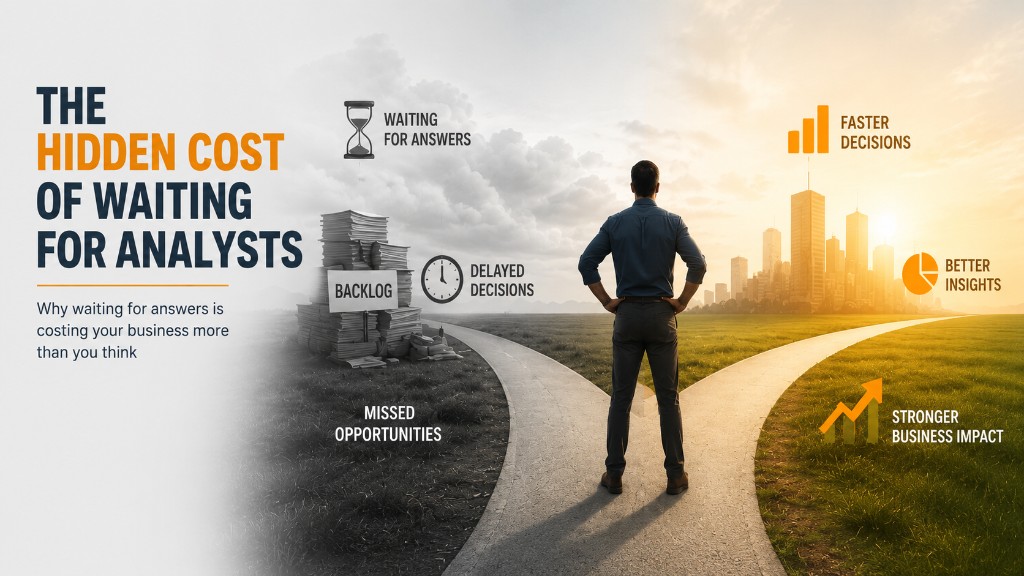
The Wait Nobody Talks About
A sales manager needs a conversion breakdown — by region, by rep, by week. She fires off a Slack message to the data team on Tuesday morning.
The report lands in her inbox Friday afternoon.
By then, the pipeline review is over. The rep she needed to coach has already moved on to the next quarter's leads. The insight arrived, technically. It just arrived too late to matter.
This isn't a horror story. This is a Tuesday at most scaling companies.
The real problem was never a lack of data. Businesses today are drowning in it — CRM logs, ad spend dashboards, product events, support tickets. The problem is access. Specifically, who gets to ask questions of that data, and how long it takes to get an answer.
The Old Workflow: A Game of Telephone
Here's what the traditional analytics workflow actually looks like in practice:
- A non-technical team member needs a number.
- They write a Slack message: "Hey, can you pull this for me?"
- The request lands in a queue — behind three other requests from product, two from finance, and a one-off ask from the CEO.
- A data analyst interprets the ask (often imperfectly), writes a SQL query, and returns a CSV or a screenshot.
- The requester looks at it, realizes they forgot to ask for a key filter, and the loop begins again.
This is data by committee — and it quietly grinds companies to a halt.
The analyst isn't the villain here. They're buried. They're doing important, highly-skilled work while also fielding a constant drip of "can you just pull one quick number" requests that consume hours of context-switching every single week.
"We had a two-week backlog on reporting requests. Our marketing team had stopped asking because they assumed the answer would come too late anyway."
— Head of Growth, Series B SaaS startup
When asking becomes a burden, people stop asking. And that's when companies fly blind.
Why It Breaks at Scale
The dependency model survives in small teams. When you have five people and one dashboard, you can get away with it.
But scale changes everything.
| Team Size | Data Requests/Week | Avg Wait Time |
|---|---|---|
| 1–10 people | ~5 | Same day |
| 10–50 people | ~30 | 2–3 days |
| 50–200 people | ~100+ | 3–7 days |
As the company grows, the number of people with data questions grows exponentially. The number of analysts grows linearly — if you're lucky.
The result is a structural mismatch. More decisions need to be made faster, but the pipeline that informs those decisions is increasingly clogged.
Add to this the specificity problem: analysts can build great dashboards for known questions. But business is full of unknown questions — unexpected trends, anomalies, sudden drops in a metric. Those questions don't fit pre-built dashboards. They require new queries, new logic, new definitions.
Every unique question is a new ticket. Every new ticket is a delay.
The Emotional Cost: Death by Slow Decisions
There's an operational cost to waiting — and then there's the cost that never shows up in a spreadsheet.
Frustration. Marketers who feel like second-class citizens in their own company because they can't access data about their own campaigns without filing a request.
Disempowerment. Founders who can't answer a board question on the fly because their metrics live inside someone else's head.
Learned helplessness. Teams that stop being curious about their data because curiosity has historically been met with friction.
This last one is the most dangerous. Curiosity is the engine of iteration. When your team stops asking questions — not because there are no answers, but because the process of getting answers is exhausting — you've lost one of the most powerful forces in a scaling company.
Slow data doesn't just delay decisions. It shapes the culture around decision-making. Teams learn to guess. They rely on intuition where they should rely on evidence. They debate the same questions in meetings that could be settled in seconds with the right query.
The hidden cost of waiting for analysts isn't just the three days. It's every downstream decision made without information, every hypothesis never tested, every opportunity that aged out while the report was still in the queue.
The Rise of Conversational Analytics
Something is shifting.
The same wave of AI capability that gave us code assistants and writing tools is now reaching the data layer — and it's quietly dismantling the bottleneck model.
Conversational analytics lets non-technical users interact with data the same way they'd interact with a knowledgeable colleague. Instead of filing a ticket:
"Show me our top 10 customers by revenue this quarter, broken down by product line."
And instead of waiting three days, they get an answer in three seconds.
This isn't about replacing analysts. Great analysts are still essential — for data modeling, for building reliable pipelines, for asking the right questions at a strategic level. What conversational analytics eliminates is the grunt work of access: the Slack pings, the CSV exports, the one-off pulls that consume analyst bandwidth without producing lasting value.
The shift is from data as a service (someone else pulls it for you) to data as infrastructure (you access it directly, whenever you need it).
It's the same transition that happened with design tools, with no-code platforms, with modern CRMs. The complexity doesn't disappear — it gets abstracted away from the people who shouldn't have to deal with it.
What Modern Data Workflows Actually Look Like
In teams that have moved past the bottleneck model, a few things look different:
1. Questions get asked in real time. Instead of preparing for a meeting by sending a request two days before, team members pull context live. A sales call reveals a pricing pattern — someone checks it on the spot.
2. Iteration is continuous, not batch-processed. Marketing doesn't wait until the end of the month to see if a campaign worked. They're adjusting based on signals that surface daily.
3. Analysts work on leverage, not logistics. When self-serve handles the repetitive requests, analysts can spend their time on what only they can do: building better models, improving data quality, asking questions the business doesn't know to ask yet.
4. Data literacy becomes a team sport. When everyone has access, everyone develops intuition. The product manager who's spent six months exploring their own metrics starts to develop taste — they know what a good retention curve looks like, what CAC movement means, what to ignore and what to escalate.
This is what healthy data culture looks like. Not a priesthood guarding access. Not a queue of unanswered requests. A team where curiosity is cheap and answers are fast.
The three-day wait for a report isn't just an inconvenience. It's a symptom of an infrastructure built around scarcity — scarce technical resources, scarce access, scarce velocity.
The companies winning the next decade aren't waiting for the queue to clear. They're building teams where anyone can ask, anyone can explore, and decisions are made at the speed of the question.